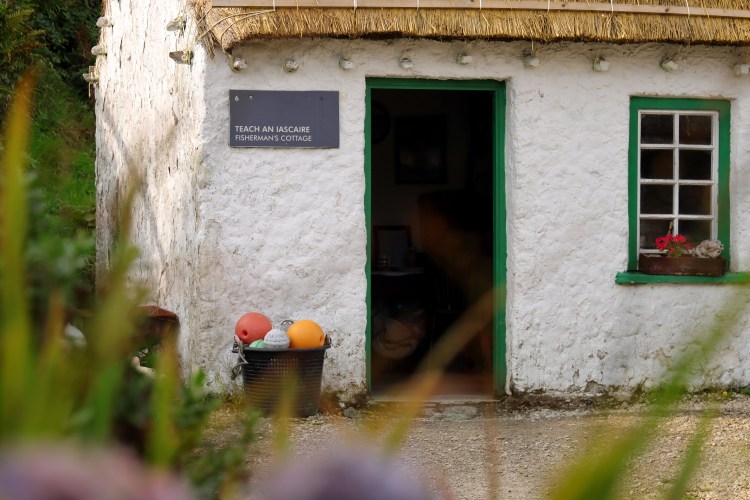
We are fortunate to live in Sligo and have the chance to go on many amazing road trips along the west coast of Ireland whenever we please.
One of our favourite places to road trip is driving through the coastal district of Glencolumbkille in south-west County Donegal.
It’s not too far distance-wise, only about 120km, but there are a lot of amazing places to stop along the way, plus I love how the region offers a much quieter, wilder alternative without the heavy crowds.
A few weeks ago, on a warm September Sunday, we revisited the Glencolmcille Folk Village, which recreates Donegal’s historic cottage dwellings, spanning over 300 years.
The museum is tucked into a rocky hillside, close to a sweeping beach, and offers anyone visiting a warm Donegal welcome and a wonderful experience of a past way of life.
It first opened in 1967 with only three cottages, which were built and furnished in just three months with the help of local community effort.
We were excited to explore a cluster of authentic, replica thatched-roof cottages representing rural life across the 18th, 19th, and 20th centuries.
We found fully furnished dwellings containing authentic artefacts and utensils, as well as a schoolhouse, a fisherman’s dwelling, and a traditional pub-grocer.
Read More: A Local’s Guide To The Best Things To Do In Bundoran, Ireland’s Surf Capital
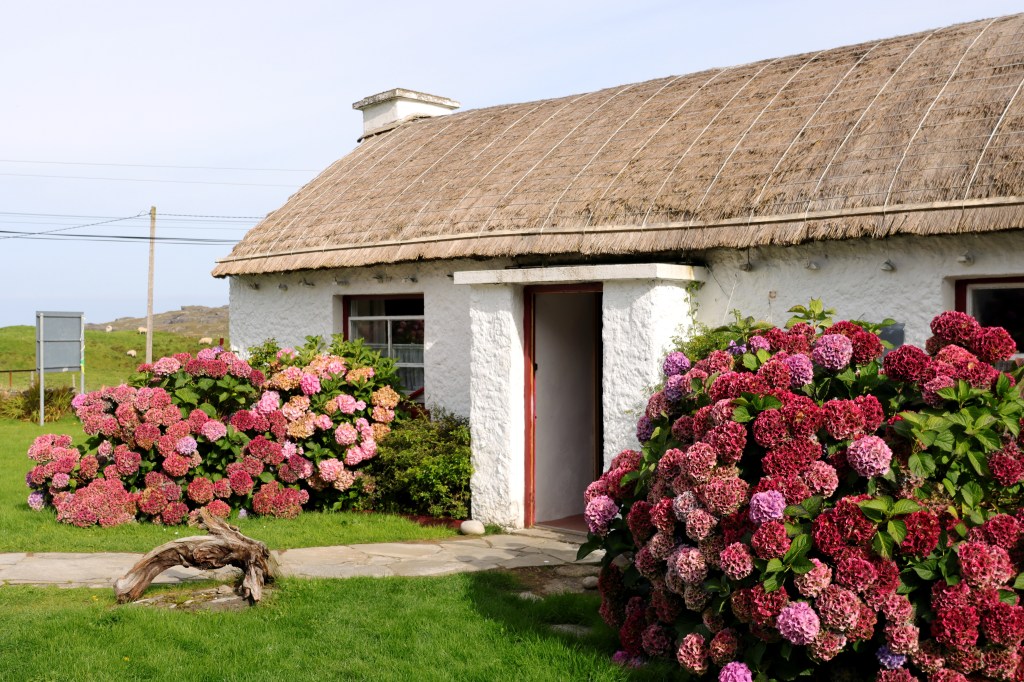
What You Will Experience
If you are ever in this part of Donegal and wish to visit the Glencolumbkille Folk Village, here’s what you can expect:
- Living-History Museum: It is a cluster of thatched replica cottages (clachán) built by the local community.
- 300 Years of History: Dwellings recreate rural life from the 1700s, 1800s, and the 20th century, complete with period furniture and utensils.
- On-Site Exhibits: Includes a traditional schoolhouse, a fisherman’s dwelling, and an old pub-grocer.
- Amenities: Features a tea house serving fresh home-baked goods and a craft shop showcasing local Irish arts and crafts.
- On-Site Facilities: A tea house serving homemade treats like fresh brown bread and soup, alongside a craft shop offering local Irish arts, woollens, and lovely souvenirs.
Read More: Your Ultimate Guide to the Best Things to See and Do in County Donegal, Ireland
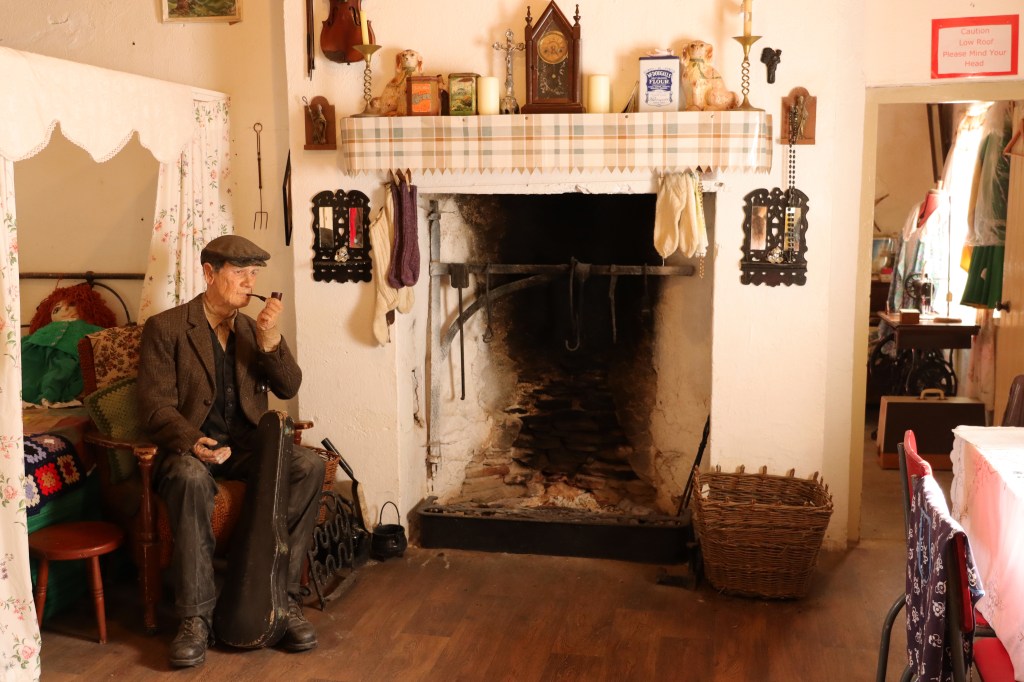
Practical Details
Location: Dooey, Glencolumbkille, County Donegal.
Admission Prices: Around €7 for adults and €6 for seniors, students, and groups.
Tour Options: Visitors can choose a self-guided experience or take an informative guided tour.
Setting: Perched on a hillside overlooking the sandy curve of Glen Bay Beach
Opening Hours:
- Easter until September 30th: Monday to Sunday, 10:00 to 18:00
- October 1st – 31st: Monday to Sunday, 11:00 to 16:30.
Read More: A Day Trip to Arranmore Island in County Donegal: An Offbeat Adventure

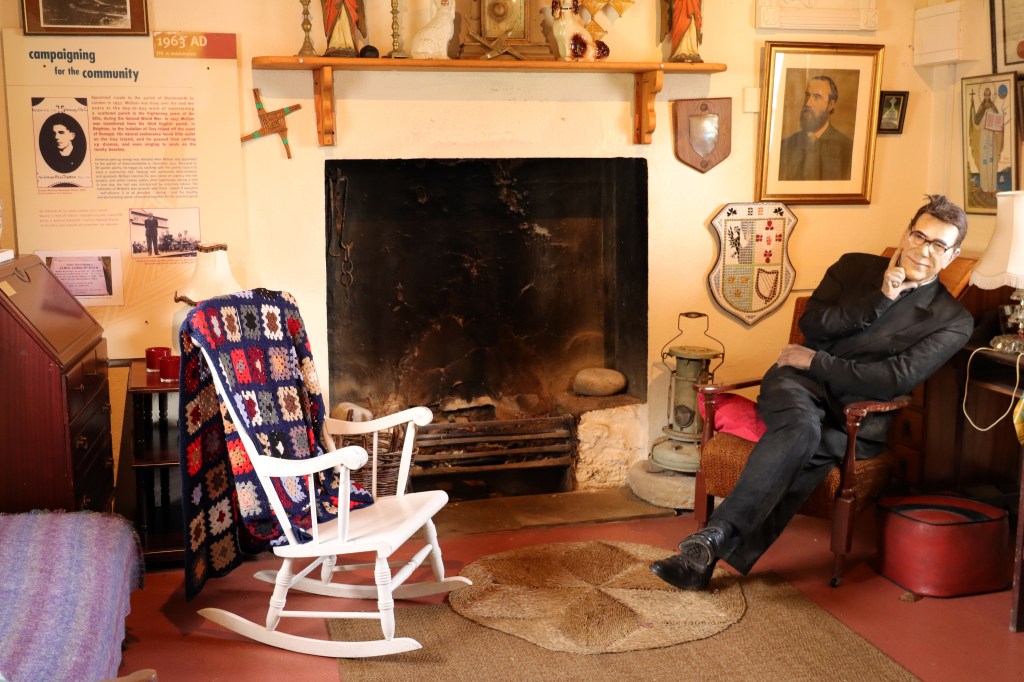
Start with the wonderful Father James McDyer Exhibition
Your visit to the wonderful Folk Village Museum will start with Father James McDyer exhibitions, whose initial idea it was to build the Folk Museum.
When a new parish priest, Father McDyer, first arrived in Glencolumbkille in 1951 on his bike, the region was suffering from a long-standing cycle of emigration, poverty and unemployment.
What’s more, people here lived without electricity, piped water, or a functioning economy.
The devoted priest, an activist by nature, worked hard for the rights of disadvantaged and underdeveloped rural areas of Ireland by organising community projects, lobbying for amenities and supporting the development of local industries, many of which, like the Folk Village, are still successful today.
His first project in Glencolumbkille was to build a community hall, followed by getting electricity and a water supply to local people.
The priest also developed tourism and set up small community-based industries like knitting and weaving, but his main achievement was radically improving the community’s living conditions.
At the exhibition, you can watch an educational audio-visual presentation honouring the local priest as well as see many artefacts.
Read More: How To Have a Fantastic Time Visiting Delightful Ards Forest Park in Donegal
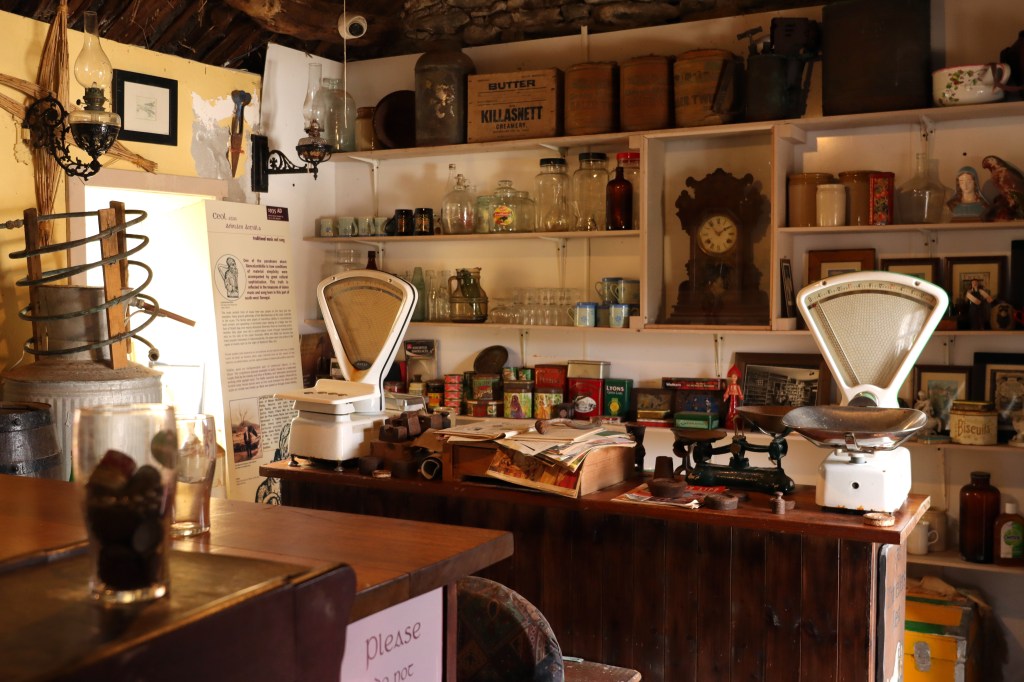
Traditional Pub-Grocer
A cottage number seven is where you’ll find a store and a pub under one roof.
In rural Ireland, it was pretty common to find a pub and a shop (often a grocery, hardware store, or post office) to share the same building.
In some small villages, a single front door led to a place split into three parts: a bar at the front, a grocery/supply shop in the middle, and an undertaker’s business in the back—all run by the same family.
The shop traditionally sold staple goods like tea, sugar, and bread, and the setup of the premises and the shopping process was much different to what we are used to now.
You just had to hand the shopkeeper a shopping list for household goods and groceries, and enjoy a pint while your bags were neatly packed.
Read More: Your Guide to Visiting the Beautiful Slieve League Cliffs in County Donegal
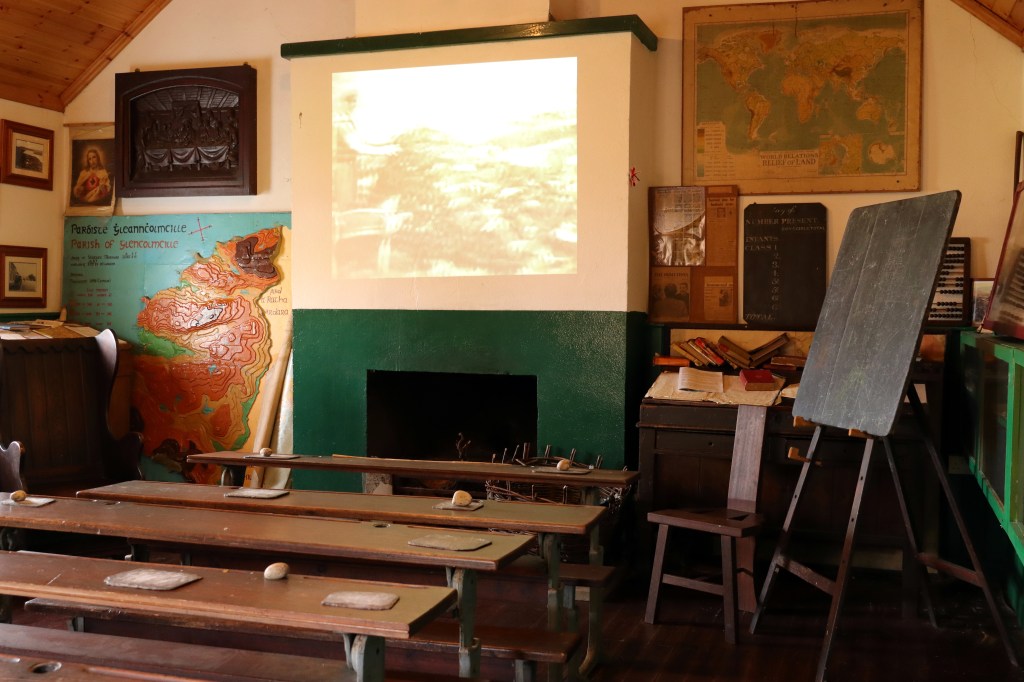
1850s School House, Officially the Dooey School House building
Seeing an old school setup complete with period desks, writing slates, and local photography displays was the highlight for our girls.
Under the Penal Laws, Catholic education was heavily restricted, so informal schools sprang up in barns, kitchens, or outdoors near hedges (hence the name scoileanna scairte or hedge schools).
In 1831, the British government introduced a state-aided national school system to replace hedge schools.
Most rural schools were simple single-room or two-room stone or plastered buildings. A single teacher often taught all children—ranging from ages 4 to 14—in the same room at the same time.
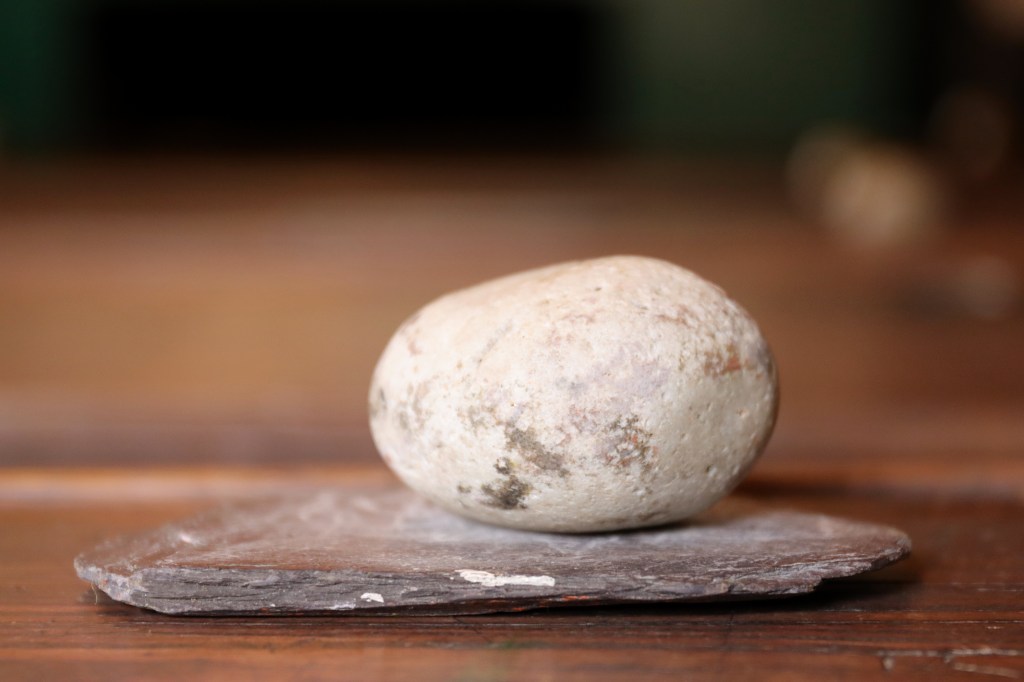
Children wrote on small slates with slate pencils, or later used official copybooks with wooden desks fitted with glass inkwells
Did you know that children in Ireland had to bring peat (commonly called turf) to school to heat the classroom?
This practice was common from the 19th century right up through the mid-20th century, particularly in rural “national schools”.
Since the schools had no central heating, during the colder months, each child brought in a sod or two of turf under their arm, which was then thrown onto the classroom’s open fire to keep the room warm for the day.
The turf was cut and saved on the bog the summer before and was a small daily contribution that kept a whole room warm.
Read More: 8 Amazing Things To See And Do On A Trip Around Inishowen Peninsula, Donegal
The Abandoned Village of An Port
After visiting Folk Village, the weather was still holding, so we set out on a drive to the remote and haunting ruins of the old famine village tucked away in the rugged western corner of Donegal, An Port.
An Port is one of Ireland’s most spectacular, raw, and remote hidden gems, perched on a jagged Atlantic coastline.
It is a wild and very peaceful place untouched by mass tourism, perfect for anyone seeking solitude.
The challenging part is getting there, as it involves a winding, 20km single-lane road with very few passing places—it is not a drive for the faint-hearted, and there are no cafes, shops, facilities or visitor centres. Just dramatic cliffs and towering sea stacks
Once you arrive, you can explore the quiet ruins of a 19th-century famine village, view offshore sea stacks, or, like us, embark on a thrilling hike up toward the breathtaking Sturrell Ridge.
- The Drive: Access is via a narrow road with sheep crossing freely, so take it very slowly.
- Safety: Swimming is strictly unsafe due to powerful waves and strong currents.
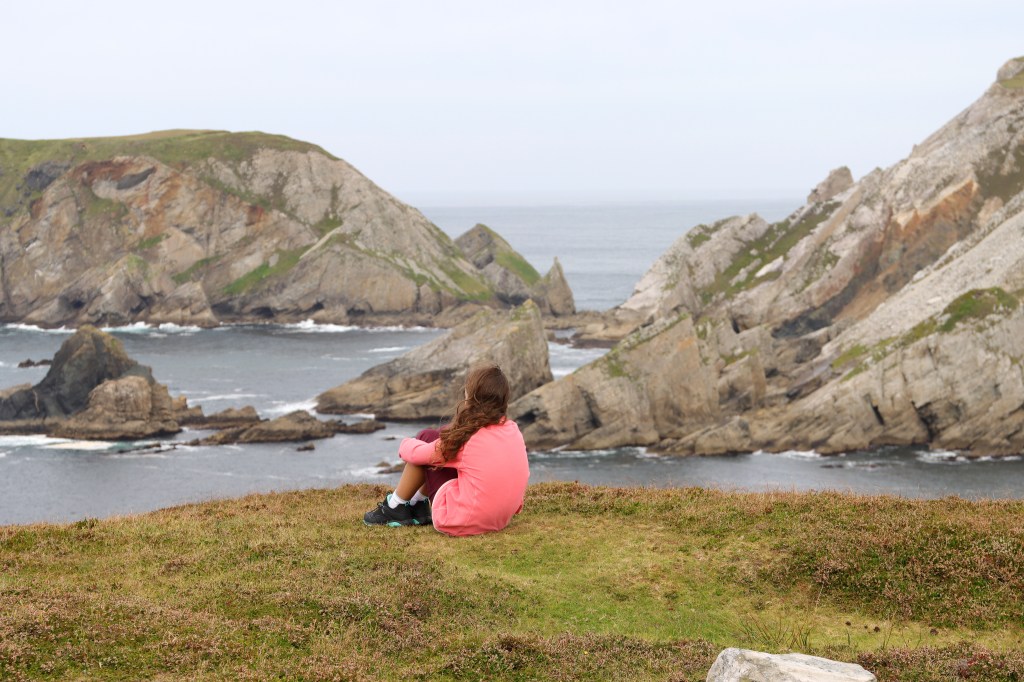
Explore Nearby Attractions – Glen Head & Signal Tower
In addition to the Folk Museum, Glencolumbkille is also known for its deep historical ties to Saint Colmcille and dramatic Atlantic landscapes, too.
The region is also well-known for the cultural and educational institute established in 1984. It offers Irish language courses, cultural events, and heritage workshops worth checking out.
A short walk from the scenic Glen Bay Beach and is located directly along the Wild Atlantic Way.
The dramatic sea cliffs of Glencolumbkille in County Donegal feature towering drops like Glen Head and the striking rock formations of the Sturrall Ridge.
Read More: 11 Amazing Things To Do In Beautiful Sligo That Will Make You Stay For More
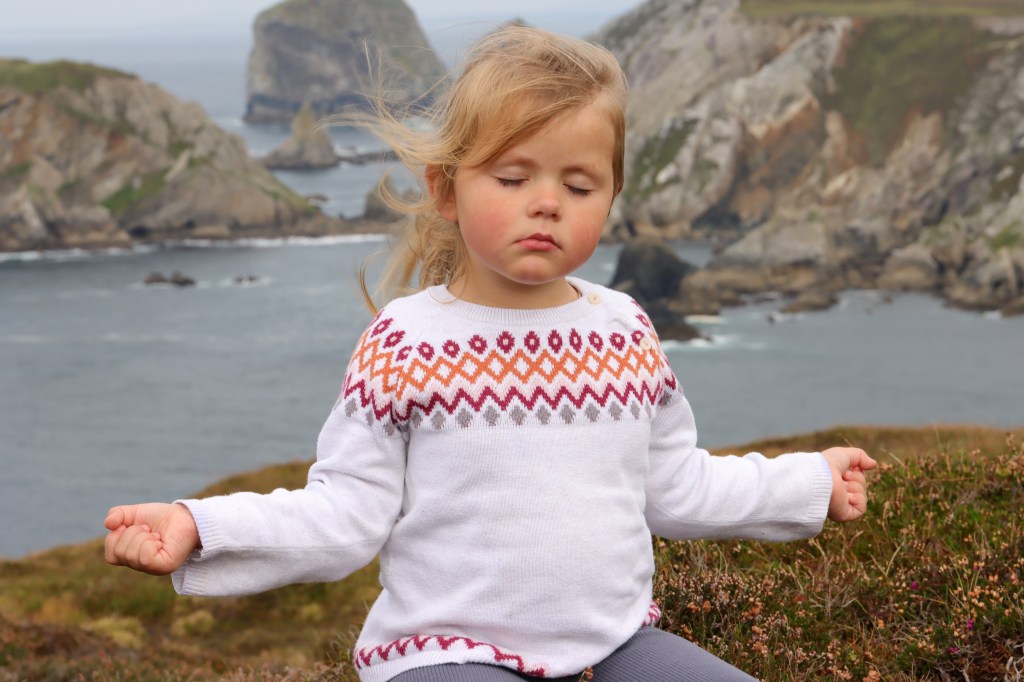
Additional places to check out if you want to extend your stay in Glencolumbkille:
- Glencolumbkille Cairns: Discover the mysterious ancient megalithic site and ancient stone structures scattered around the local landscape
- Glen Head & Signal Tower: A soaring 220-meter cliff featuring a historic Napoleonic-era lookout tower that resembles a medieval castle.
- The Sturrall Ridge: A razor-thin, dramatic rock ridge and headland extending into the Atlantic Ocean
- Traditional Pubs: Make sure you take time to enjoy authentic local atmosphere and live traditional Irish music—particularly fiddle sessions—at village spots like Roarty’s Bar or Biddy’s
- Local Dining: Check out An Cistin Restaurant, John Eoinin’s Bar & Restaurant, or local village cafes if you are looking for something to eat
Read More: How To Have a Fantastic Time Visiting Delightful Ards Forest Park in Donegal
… … … … … … … … … … … … … … … … … … … … … …
Now, over to you!
Have you been to Glencolumbkille Folk Village? Let us know in the comments below!
Please let us know if you plan to visit Glencolumbkille Folk Village and have any travel-related questions.
Subscribe For The Latest In Travel Inspiration
Subscribe to our monthly email newsletter to stay up to date with all our outdoor adventures
Enter your email below to receive updates


Oh I love this! I will definitely add to my bucket list for when I’m home in Ireland.
LikeLiked by 1 person
It’s a pretty cool place to visit—a living archive of endangered or lost artisanal knowledge, such as historic farming techniques, traditional building methods, baking, and hand-weaving—that you can’t learn from a textbook. Thanks for stopping by, and have a good day 🙂 Aiva xx
LikeLiked by 1 person
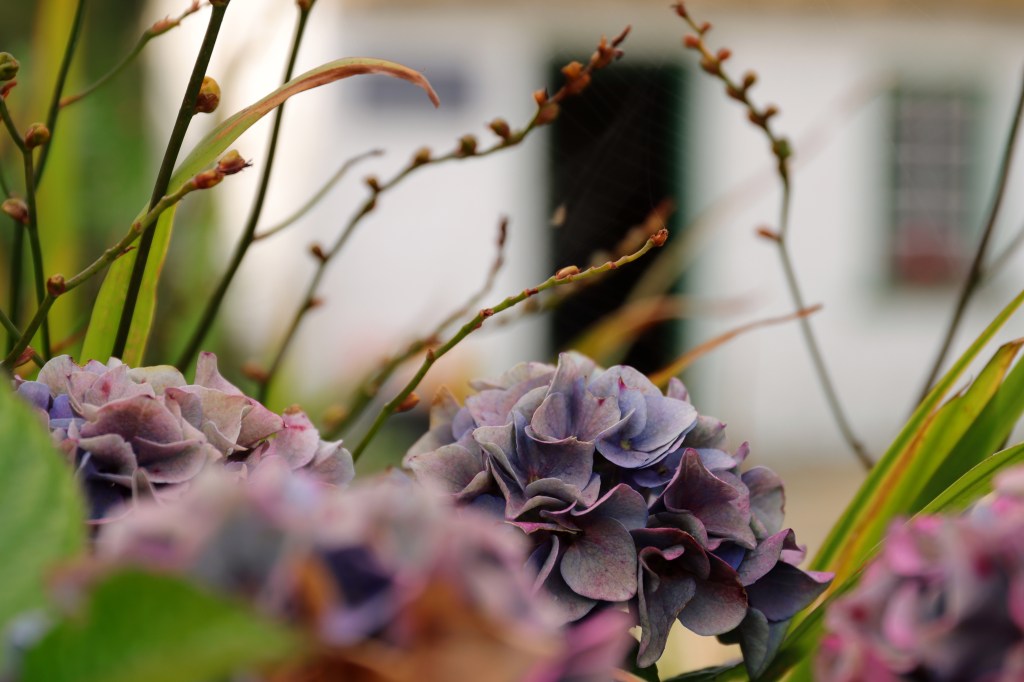
I’d visit just to see those magnificent hydrangeas
LikeLiked by 1 person
You would love those beautiful hydrangeas – they were abundant and in full bloom. Thanks for stopping by, and have a good day 🙂 Aiva xx
LikeLiked by 1 person
Thanks Aiva
LikeLike
We just visited a couple of these in Poland. They are a great way to further understand the people aren’t they. Maggie
LikeLiked by 1 person
That’s so true, dear Maggie, especially since they’re so well-researched and transportive. Thanks for stopping by, and have a good day 🙂 Aiva xx
LikeLike
What a beautiful place. The museum looks fascinating, I enjoy living history style museums much more than traditional, exhibits-in-a-case style places. I didn’t get to explore much of Ireland when we were living in Belfast, but I’d love to plan in an Irish road trip at some point. So much to enjoy!
LikeLiked by 1 person
I am glad that you like living history style museums, too.
Our family, especially the girls, love them because instead of reading plaques behind glass, you can walk through full-scale reconstructed towns, farms, or ships, engaging all five senses (seeing period architecture, hearing blacksmiths and horse-drawn carriages, and often tasting historical foods).
There is another museum in Northern Ireland we visited recently, called the Ulster Folk Museum, and it’s even better than the one in Donegal, as it has more than 50 exhibit buildings. The museum is home to an amazing collection of objects, which it uses to actively preserve and demonstrate traditions, stories and skills passed down through many generations of people in Ulster. You would love it.
Thanks for stopping by, and have a good day 🙂 Aiva xx
LikeLike
We were there in 2017, but it was not open, so thanks for taking us inside Aiva. On our recent trip, we just plain ran out of time to stop there again. Ireland and Donegal is such a beautiful part of the world. Thanks for your ideas on what to see when we were there. Such a cute photo of Madara. Happy Monday. ALlan
LikeLiked by 1 person
During our previous trips along Southwest Donegal, we always somehow just passed by without stopping. But this year, the blooming hydrangeas were so beautifully inviting that we just had to visit. I have always loved how such living history museums provide authentic sights, sounds, and tastes, as well as how they make history accessible and experiential. Thanks for stopping by, and have a good day 🙂 Aiva xx
LikeLiked by 1 person
I always enjoy museums like this and seeing how people lived back in the day. Always makes me happy for modern amenities. The landscape sure is stunning! Glad you all could make the road trip and have such a wonderful time.
LikeLike
What an excellent guide! My husband would love to visit Glencolumbkille Folk Village, as it’s right up his street (and mine, too, as we love historic cottage dwellings and traditional buildings). It’s incredible that people lived without electricity, piped water, or a functioning economy and really makes me reflect on how fortunate I am to have these things, particularly hot water! The living history museum sounds fascinating, as does the Father James McDyer exhibition, and I like the way you can walk into rooms that show how life was for people; exhibits like this are so atmospheric! The authentic thatched roof cottages sound fascinating, too; we like to see how traditional buildings were constructed in the past. Thanks for sharing. 🍂❄️💜
LikeLike
We visited in the summer of 2014 and it was a very interesting place. Thanks for the reminder. (Suzanne)
LikeLike
I always love places like this that give a real look at what life was. I would definitely love to visit here, especially since I have so much family that came from this area. Also, what beautiful pictures of your girls 🙂
LikeLike
We always enjoy visiting open air museums like this. They really show how people once lived. Your girls are growing up fast.
LikeLike
Lovely! There’s another side to Ireland that not many tourists know about, especially Glencolumbkille. Looks like a peaceful tour around town, all the while carrying stunning flowers!
LikeLike
I have not been there, but thanks to you and this post I now want to visit!
LikeLike
Looks beautiful Aiva.
LikeLiked by 1 person
Looks like such a great day out Aiva. It’s great to learn about the area’s heritage, and even better with those coastal views to enjoy along the way 🙂 xx
LikeLike